Taps & stopcocks
Tap and Stopcock Repairsin Lytham St Anne's, Drips Stopped, Isolation Restored
A tap that has dripped for months and a stopcock that will not turn are the two small faults that cost the most later, one wastes metered water daily, the other is why a minor leak becomes a flooded ceiling at midnight.
Free assessment · Fixed written quote · Same-day attendance on smaller jobs · 12-month workmanship guarantee
24/7
Emergency response, every day of the year
£1m
Public liability insurance in force
12 mo
Workmanship guarantee on every job
5.0
Google rating from 8 reviews
Free
Survey, then a fixed written quote
What this covers
Small jobs that decide how the next emergency goes
This service covers everything valve-related in a domestic property: dripping and stiff taps, worn ceramic cartridges and washers, leaking spouts and bases, mixer and monobloc taps, outside taps, seized or weeping main stopcocks, failed isolation valves at appliances, and the addition of new isolation valves where none exist.
It is deliberately treated as proper work rather than a filler job. A tap replaced badly is a tap that seizes into the basin within two years, and a stopcock replaced with the wrong valve type is a stopcock that will not turn when it is needed most. The parts are cheap; the consequences of getting them wrong are not.
Stopcocks deserve particular attention. The main stopcock is the single control that determines whether a burst pipe is a two-minute inconvenience or a whole-house flood, and in older properties across Lytham St Anne's and Preston they are very frequently seized solid from decades of never being turned. Renewing one is a short job with a disproportionate payoff.
Tap work covers both repair and replacement. Where a quality tap has simply worn a cartridge or seat, repairing it is the sensible route. Where the body is corroded, the fitting is failing at the base, or the tap is a low-grade unit that will fail again, replacement is the honest recommendation, and you will be told which situation you are in.
Assessment is free, quotes are fixed and written, and smaller jobs can often be attended the same day depending on the size of the job and what is already booked in.
Who it is for, and when
A tap that drips or will not shut off
Worn cartridges, perished washers and pitted seats. Cheap to fix, expensive to ignore on a metered supply.
A stopcock that will not turn
The most important valve in the property, and the one most likely to be seized. Renewing it restores your ability to stop a leak instantly.
Leaks at the base or spout of a tap
Usually a failed O-ring or seal at the spout swivel, or a loose backnut under the basin allowing movement.
No isolation valves at appliances
Without them, changing a tap or fixing an appliance feed means draining the whole property. Adding them is quick and cheap.
What happens if it waits
The cheapest fault in the house, left long enough to become the most expensive
A dripping tap is not neutral. On a metered supply it is a continuous, measurable cost that runs every hour of every day, and unlike most waste it never stops or reduces; it only gets worse as the seat wears further.
The drip also damages what it lands on. Constant water over a ceramic surface leaves staining and limescale scarring that will not clean off, and a slow leak at the base of a tap runs behind the basin or into the cupboard below, where it quietly rots the carcass and the floor underneath it.
Stiff taps fail in a different way. When a tap needs real force to shut off, that force goes into the tap body, the backnut and the pipework tail beneath it. Over time it loosens the fixing, works the connection underneath, and eventually turns a tap fault into a supply leak under the basin.
The stopcock is the serious one. Every emergency plumber's worst call is the customer with a burst pipe and a stopcock that will not move, because from that point on, water keeps running until the external supply can be reached. A minor split that should have cost one fitting instead soaks a floor, a ceiling and everything below.
There is also the DIY escalation. A tap change attempted without isolation, without the right spanner and with corroded backnuts routinely ends in a snapped tail, a stripped fitting or a partly dismantled basin with the water off, and then it becomes an emergency call-out on a Sunday rather than a booked job on a Tuesday.
Common mistakes we get called out to fix
- Tightening a dripping tap harder each time instead of replacing the cartridge, destroying the seat completely.
- Assuming the stopcock works because it is there; most people discover it is seized during the emergency itself.
- Forcing a seized stopcock and snapping the spindle, removing the only isolation the property had.
- Fitting the cheapest available tap into a hard-water area, then repeating the job in eighteen months.
- Starting a tap change without isolation valves and without knowing whether the stopcock actually holds.
- Ignoring a wet cupboard base under the sink because the tap 'only drips a bit'; that water is in the floor.
Our process
Five steps, in the same order, every time
01
Inspection
The tap, valve or stopcock is assessed along with the pipework and fixings behind it, because the condition of the tail, backnut and isolation determines what the job actually involves.
02
Diagnosis and honest recommendation
Repair or replace, stated plainly: cartridge, washer, seat or seal where the unit is sound, replacement where the body is corroded or the fitting will not survive another service.
03
Fixed written quote
Priced before work starts, including any isolation valves worth adding while access is open, so there are no additions once the job is underway.
04
Fit and repair
Water isolated properly, corroded fittings cut out rather than forced, new taps or valves fitted securely with clean sealing and correctly supported tails.
05
Test, verify and guarantee
Checked under full pressure hot and cold, isolation proven to actually shut off, the area left clean, and the work covered by a 12-month workmanship guarantee.
What you actually get
The difference it makes once it's done properly
The drip stops permanently
The worn component is replaced and the seat checked, rather than the tap being nipped up to buy a few more weeks.
You can turn your water off again
A working stopcock is what turns a future burst into a two-minute problem. It is the highest-value small job in any property.
Metered water stopped leaving
A continuous drip is a continuous charge. Ending it pays for itself on a metered supply faster than most people expect.
Future jobs get cheaper
Isolation valves added at appliances and basins mean the next repair does not require draining the whole property.
Fittings that survive removal
Corroded backnuts and tails cut out and renewed properly, so the next service is a straightforward job rather than a snapped-tail emergency.
Guaranteed and insured
12-month workmanship guarantee, manufacturer warranties up to five years on parts subject to their terms, and £1,000,000 public liability insurance.
In detail
Tap types, valve types, and what a proper repair involves
Most tap and valve faults come down to a handful of components. Knowing which one has failed is what separates a fix that lasts from one that reappears next season.
Tap mechanisms and their failure modes
Traditional pillar taps use a rubber washer compressed onto a brass seat. They fail when the washer perishes or the seat pits, and a pitted seat will destroy a new washer quickly, which is why simply swapping the washer sometimes lasts only weeks.
Quarter-turn and lever taps use ceramic disc cartridges. They fail when grit or limescale scores the discs, producing a drip or a gritty feel through the handle. Cartridges are replaceable, but must match the tap by size, spline and handedness.
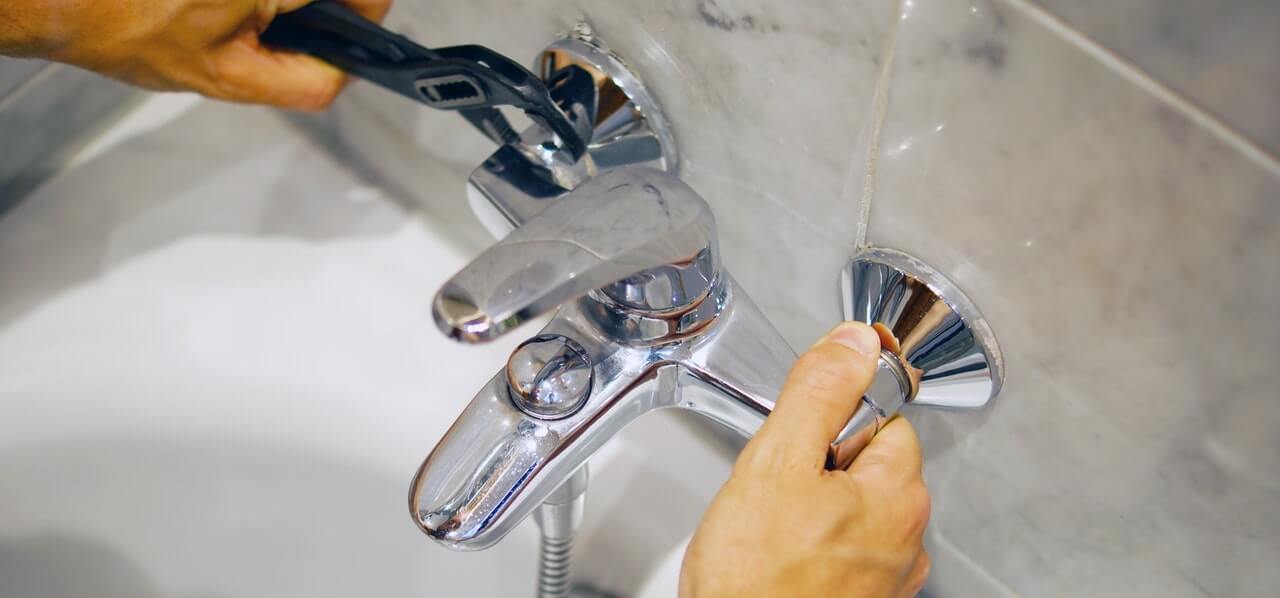
Monobloc mixers combine hot and cold through a single body with a cartridge and flexible tails. Common faults are cartridge wear, spout O-ring failure causing a leak at the base of the spout, and loose fixings allowing the whole tap to rock and work its connections.
Stopcocks, isolation valves and system control
The main internal stopcock is usually under the kitchen sink, in a downstairs cupboard or near the point of entry, with an external stop tap at the boundary. Both should be tested occasionally; a valve never turned is a valve that will not turn.
Seized stopcocks are extremely common in older housing stock. The gland packing hardens and the spindle corrodes into the body. Renewal replaces the valve entirely, and modern lever-type or full-bore valves are far less prone to seizing than the old gate patterns.
Isolation valves, small in-line valves at appliances, basins, WCs and cylinders, are the practical upgrade most properties are missing. They allow a single fitting to be worked on without draining the house, and they are inexpensive to add during any other job.
Hard water, coastal conditions and material choice
Limescale is the main enemy of tap mechanisms: it scores ceramic discs, blocks aerators and hardens around spindles until the tap feels stiff. Cleaning or replacing an aerator often restores flow that was assumed to be a pressure problem.
Coastal properties see accelerated corrosion on exposed and outside taps. External taps also need a means of isolation and, ideally, draining down before winter, a frozen outside tap frequently splits the pipe inside the wall rather than the tap itself.
Quality matters more than style in a hard-water area. A tap with a serviceable, standard cartridge can be repaired for years; a sealed low-cost unit becomes disposable at the first fault.
Kitchen, bathroom and outside tap variations
Kitchen taps take the heaviest use in any property and are the most likely to loosen at the base through constant lever movement. Deep sinks and tight cupboard access make backnut work awkward, which is where the right tools save the sink.
Bathroom basin and bath taps are more often replaced for a failed seal at the base than for a dripping spout, and bath taps in particular suffer from restricted access behind the panel; worth combining with other work when a bathroom is being altered.
Outside taps need a check valve arrangement and an isolation point inside. Fitting one properly includes making the internal connection serviceable so it can be drained ahead of a freeze.
Repair versus replacement
Repair is the right answer when the tap body is sound, the finish is intact and the cartridge or washer is a standard serviceable part. This is the cheapest outcome and it is recommended whenever it will genuinely last.
Replacement is the right answer when the body is corroded, the base fixing has worn, the spout swivel has play in it, or the unit is a low-grade tap that has already failed once. Repairing those repeatedly costs more than replacing once.
Either way, the recommendation comes with the reason attached, and the quote is fixed in writing before anything is dismantled.
Boiling water taps and under-sink filters
Boiling water tap installations are carried out as part of the same work: the unit under the sink needs a spur, a secure mounting point and enough clear cupboard space around it for servicing, and the survey confirms all three before anything is ordered.
Under-sink water filter installations are handled the same way, teed off the cold feed with its own isolation valve so the cartridge can be changed later without turning the house off.
Both are quoted fixed in writing after the survey, and both come with the 12-month workmanship guarantee; the unit itself carries its own manufacturer warranty.
Residential, rentals and small commercial
In rented property, taps and isolation are the most common cause of repeat call-outs. Fitting serviceable taps and adding isolation valves reduces both the frequency and the cost of future visits considerably.
In holiday lets and properties left empty over winter, common along this coast, a working stopcock and drainable outside tap are the two things that most reduce the risk of an unattended burst.
Small commercial premises with washrooms and kitchens are covered for the same work, typically scheduled outside trading hours where the water needs to be off.
Common questions
Answers before
you pick up the phone
Still unsure? Ring Jack on 07474 039934; advice costs nothing.
Related services
- Plumbing & HeatingGeneral plumbing and maintenance across the home, from pipework repairs to radiator fault diagnosis.
- Leak DetectionTracing hidden leaks in pipework and appliance feeds before they damage floors, ceilings and plaster.
- Emergency Call Out24/7 response for burst pipes, sudden leaks and lost hot water, contained fast, then repaired properly.
- Hot Water Cylinder & Element RepairsDraining cylinders and tanks, replacing immersion heating elements and thermostats to restore hot water.
- All plumbing and bathroom services
- Pro Plumbing Solutions home
Where this service is available
Not listed? Ring anyway, most of the Fylde coast and central Lancashire is still workable. You can also send the job details through the contact form.
Stop the drip, and make sure you can turn the water off
Free assessment, a fixed written quote, same-day attendance on smaller jobs where the schedule allows, and a 12-month workmanship guarantee on every repair.
Free initial survey · Fixed written quote · £1,000,000 public liability insurance · 12-month workmanship guarantee